AI assistants that know your work
Assistants built to your requirements, trained on your processes, your policies, your language. They answer how you'd answer, not like a generic bot.

Assistants, integrations, and workflows built around how your team actually works, not demo theatrics.


Evidence Start with useful work
Every solution starts with your actual data and workflows, not a generic demo. We measure success by time saved, not novelty.
See automation work →Most teams aren't short on tools or data. They're short on time: hours spent re-typing the same figures, hunting for answers in documents nobody can navigate, and moving files between systems that won't talk to each other.
That's the manual work we cut. Not for the sake of having AI somewhere, but for the hours it gives back. Every engagement starts with one question: what's eating your team's time?
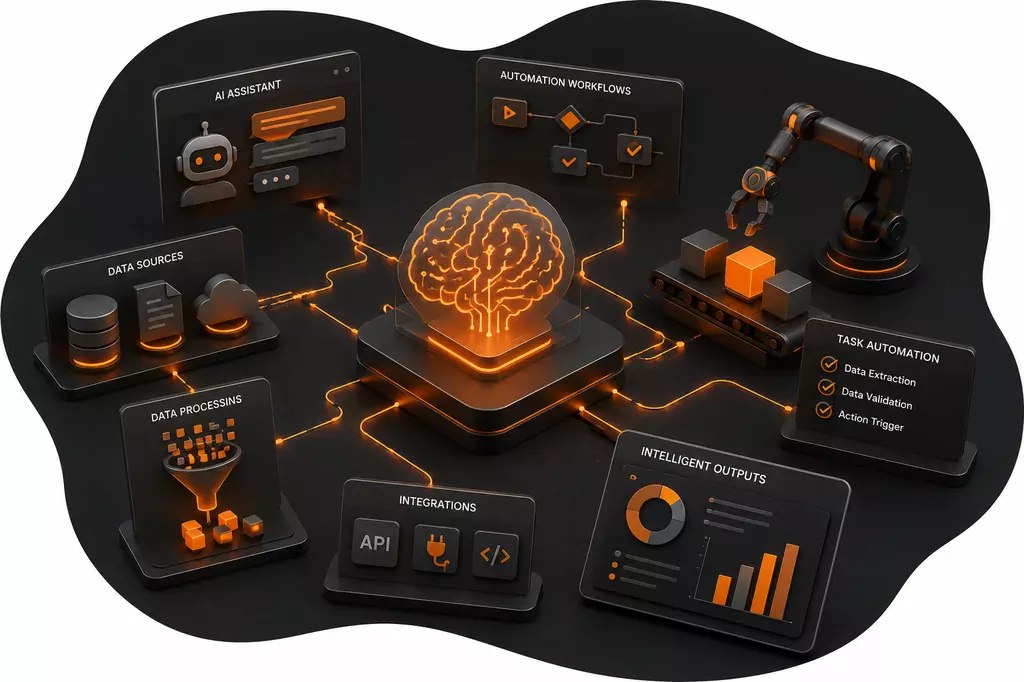
01 Six Ways to Take Work Off Your Team
Assistants built to your requirements, trained on your processes, your policies, your language. They answer how you'd answer, not like a generic bot.
Search your policies, wikis, and contracts in plain language instead of hunting through folders. Technical name: RAG systems with vector search.
AI built into the CRM, helpdesk, and document systems you already pay for, drafting replies, summarizing cases, and flagging what needs a human.
Tools that won't share data get connected with API integrations between your CRM, accounting, helpdesk, and storefront, so nothing is typed twice.
Manual steps, approvals, and data entry removed from the jobs that repeat them, from invoicing and reporting, onboarding, and the other routines your team dreads.
When no off-the-shelf AI or automation tool fits, we build one around the problem, scoped, documented, and maintained like any other piece of software.
02 The approach
We start from the task your team repeats most, and measure it in hours, not in what a vendor's demo says is painful.
If automation won't earn back its cost within a sensible window, we tell you and stop there. That's the deal.
New assistants and workflows land inside the systems your team already uses. No forcing people into a new platform.
We check answers and outputs against actual cases before anything goes live, and we stay around after it does.
03 Straight answers
No. We automate the repetitive, rule-based parts of the job: data entry, copy-pasting between tools, hunting for answers in documents, so your people spend their time on work that needs judgment.
No. We work with what you have. Messy or scattered data gets cleaned and structured as part of the setup, not before it.
We scope hosting and models to your risk. For sensitive or regulated data we use private or on-premise setups so it stays under your control, and we never train public models on your data without written consent.
A generic chatbot gives generic answers. We build assistants around your processes and your documents, so they answer from your policies and data, and we verify they work on real cases before they go live.
Start with one process that eats the most time. If automation won't pay for itself, we'll tell you so before you spend anything.
Tell us. We'll show you what AI or automation could take off your plate, and what it would cost.